Set up ITOps360
The four Get started steps - connect Microsoft Entra ID and Intune (or Active Directory), add devices with the agent or a site collector, set up the service catalog and invite technicians.
Online version, always current: https://cloudone.tech/docs/guides/set-up-itops360/
ITOps360 is your service desk, device management and IT automation in one place. A new organization opens on a Get started card with four steps, each ticked off from real data. You need the CustomerAdmin or ItManager role. Each step’s How to link opens its section of this guide.
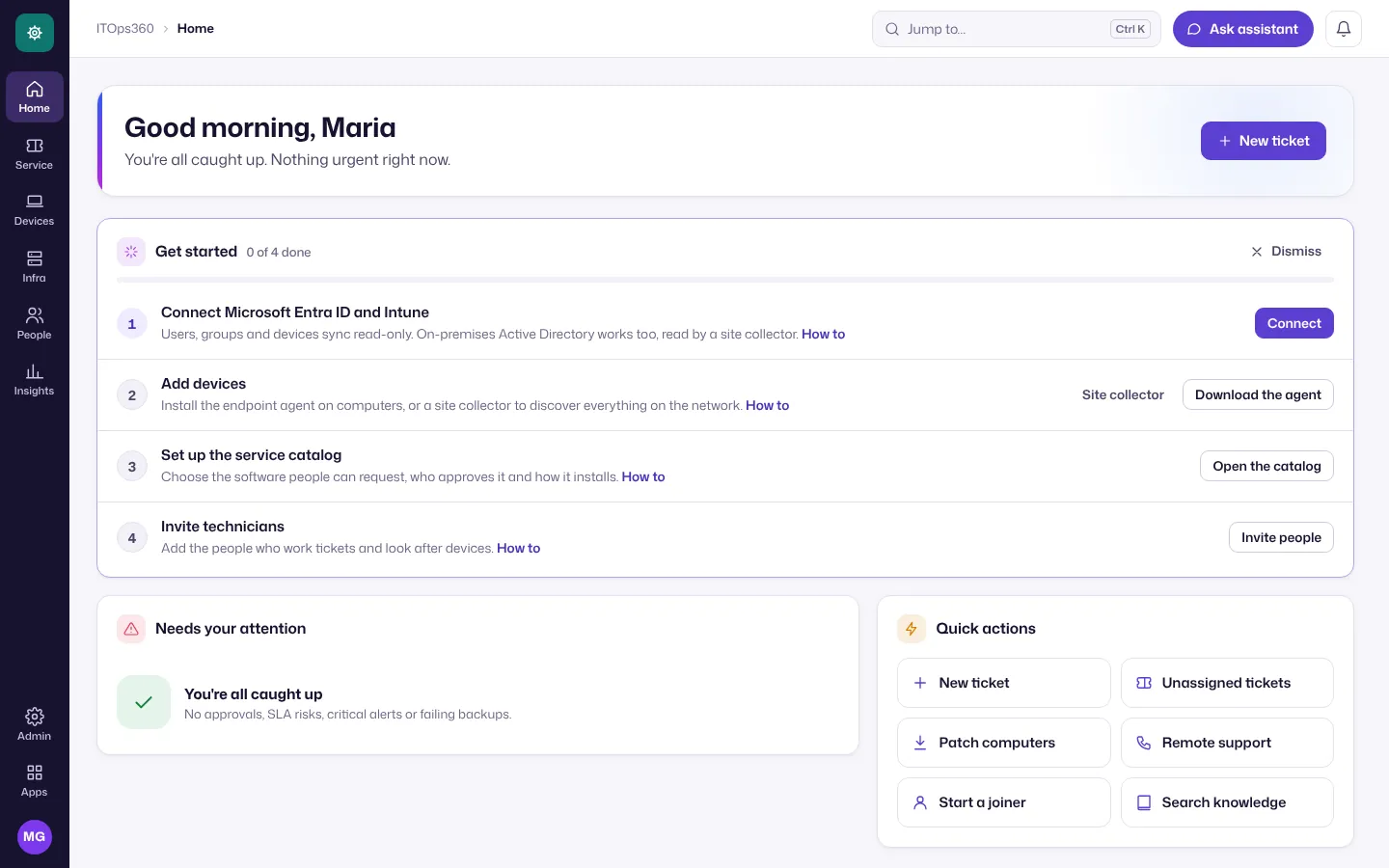
Connect Microsoft Entra ID and Intune
Users, groups and devices sync read-only from Microsoft Graph. Remote actions (wipe, restart, install) need a second, write-scoped app registration that you add later, only if you want them.
-
On the Get started card choose Connect (or Admin → Settings → Integrations).
-
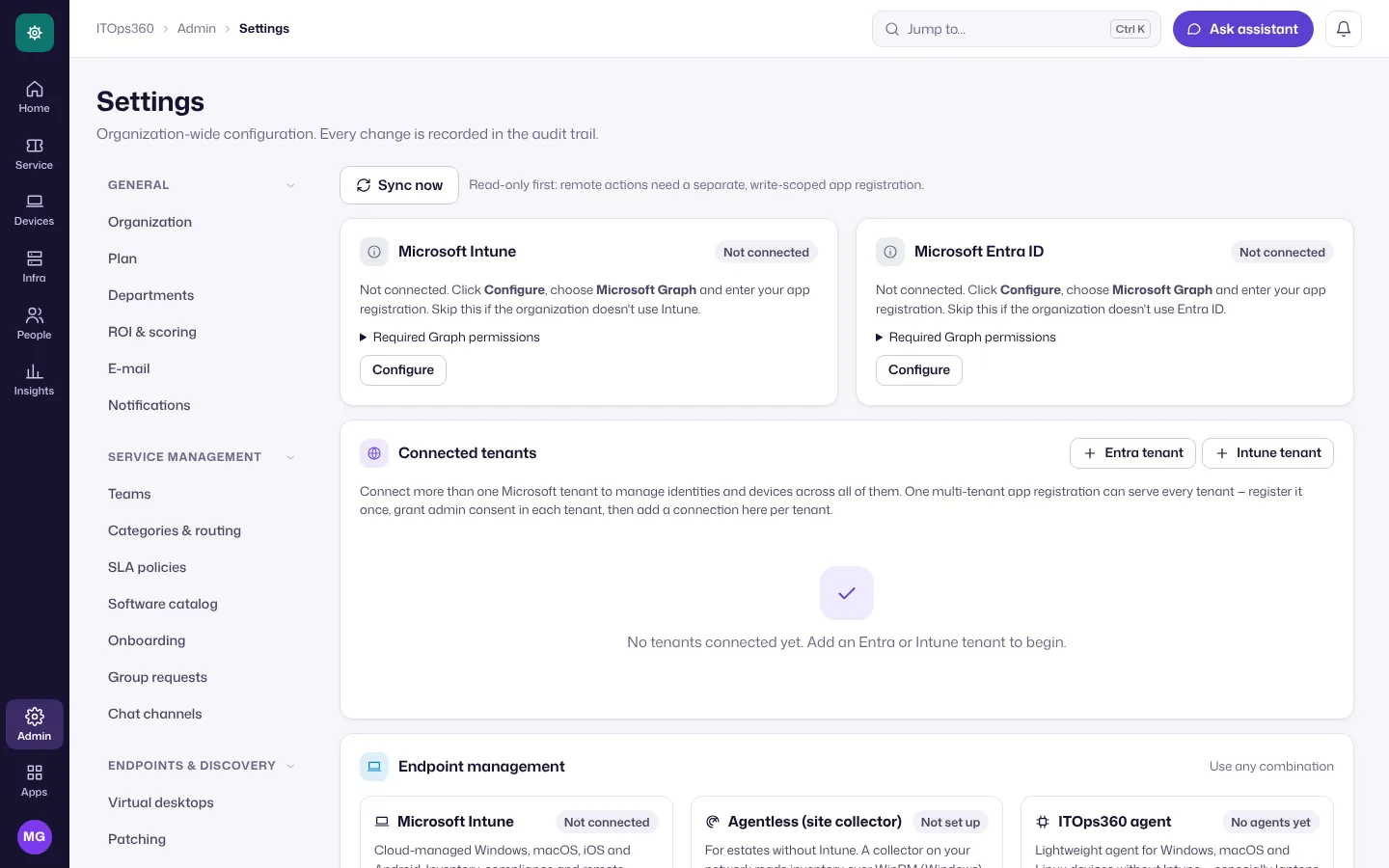
In Microsoft Entra ID, create an app registration and grant it the Graph application permissions listed under Required Graph permissions on each card, then grant admin consent.
-
On the Microsoft Entra ID card choose Configure. Keep Mode on Microsoft Graph, enter the Directory (tenant) ID, the Read-only app client ID and its client secret, and choose Save. Do the same on the Microsoft Intune card if you use Intune (the same app registration can serve both).
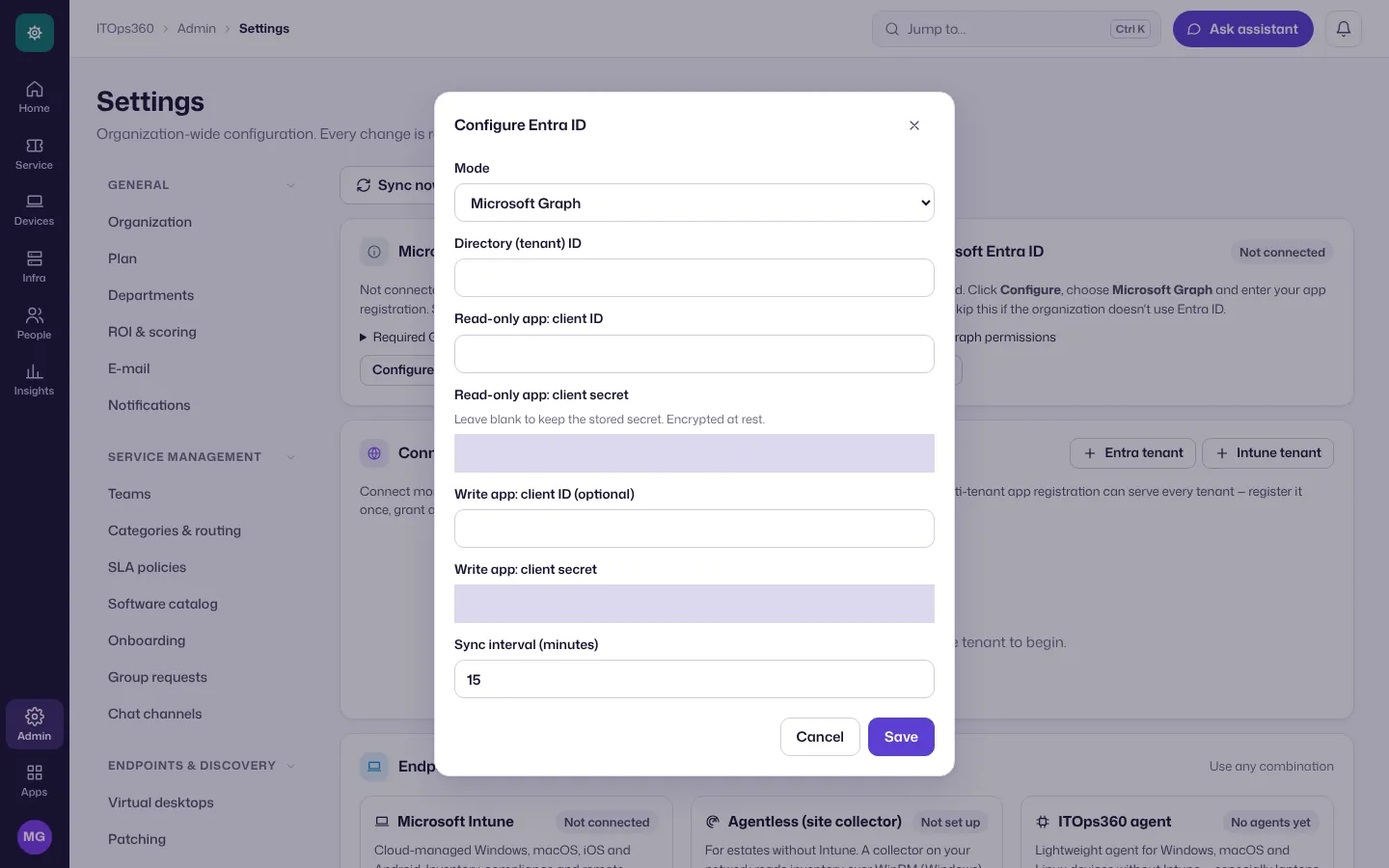
-
Choose Sync now. People, groups and devices appear within minutes, then sync on the interval you set.
Several Microsoft tenants? Add each one under Connected tenants (Entra tenant, Intune tenant). On-premises Active Directory is read by a site collector instead (next step). Details: Connect identity and devices and Active Directory and Entra ID.
Add devices
Devices managed by Intune arrive with the Intune connection. For the rest, use one or both of these:
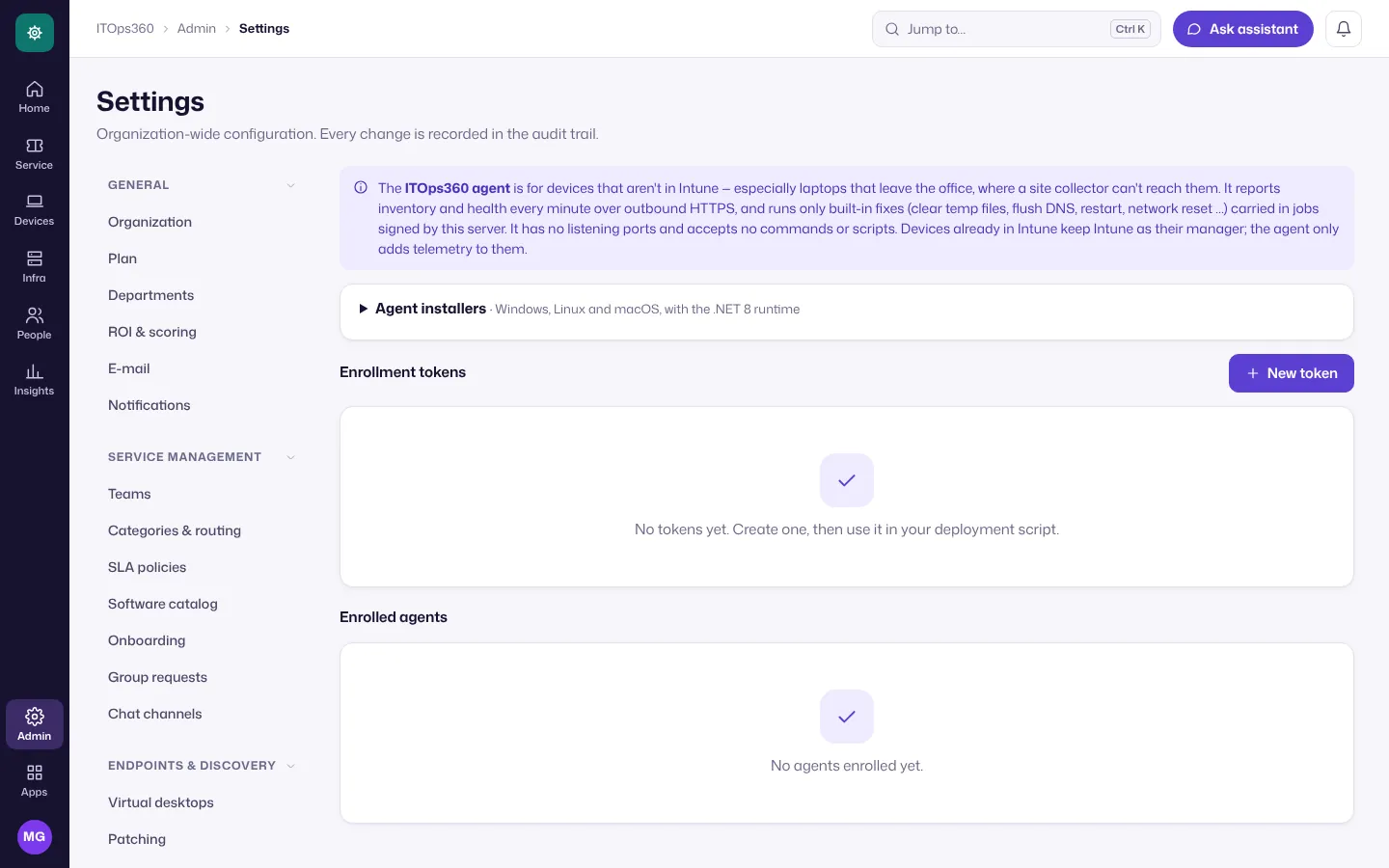
The ITOps360 agent (Windows, macOS and Linux laptops and servers, especially those that leave the office):
- Choose Download the agent on the card (or Admin → Settings → Endpoint agents).
- Choose New token under Enrollment tokens. Copy it now: it’s shown once.
- Download the installer for each platform under Agent installers and deploy it with the token (by hand, Group Policy, Intune or your RMM). Devices appear under Enrolled agents and in Devices.
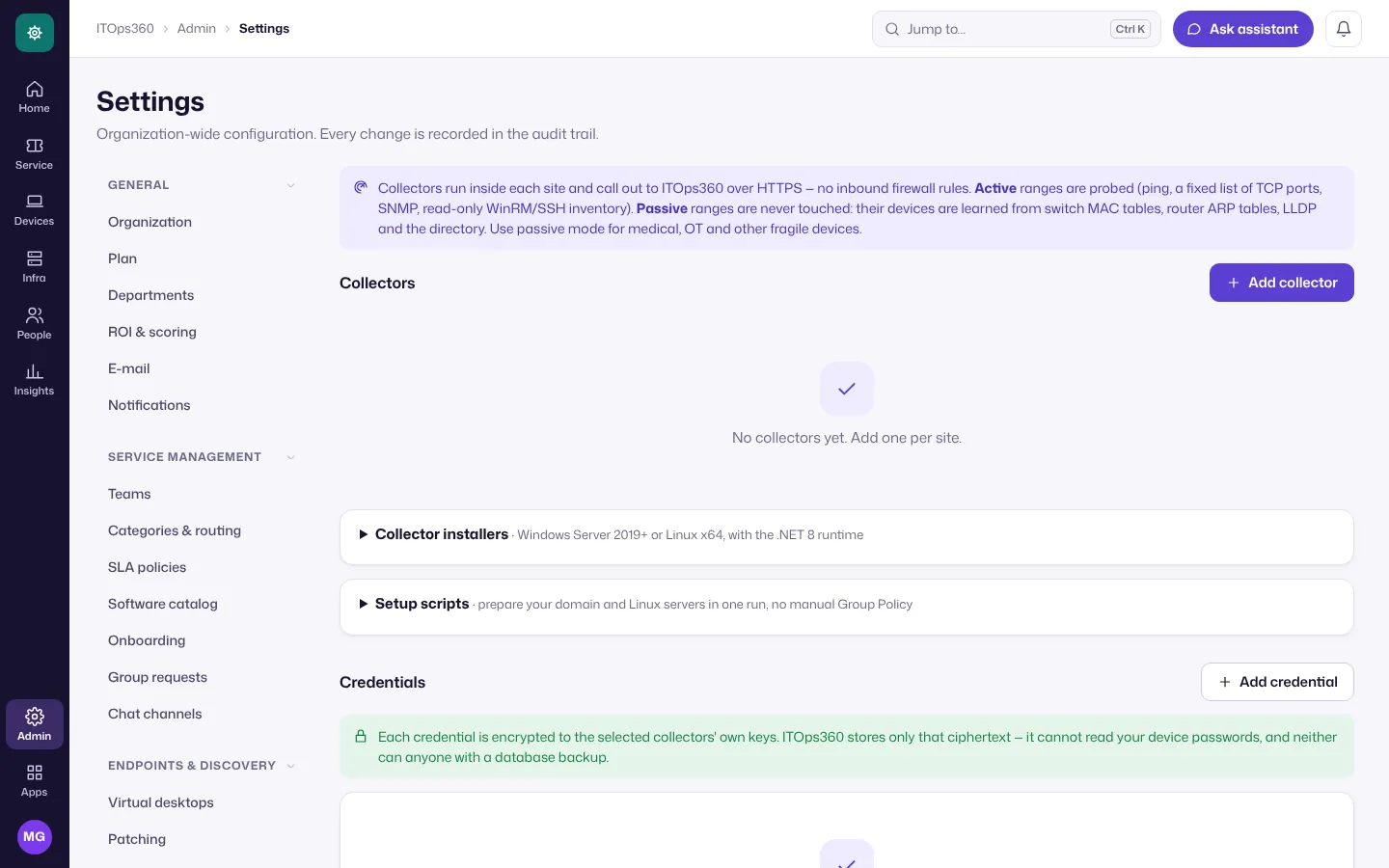
A site collector (agentless: discovers everything on a network, including printers, switches and on-premises Active Directory):
- Choose Site collector on the card (or Admin → Settings → Discovery), then Add collector.
- Install it on a Windows Server 2016+ or Linux machine at the site, using Collector installers and Setup scripts.
- Under Credentials, add the read-only accounts it should use (WinRM, SSH, SNMP, LDAP). They’re encrypted with the collector’s own key: ITOps360 can’t read them.
More in Agent and agentless and Discovery and assets.
Set up the service catalog
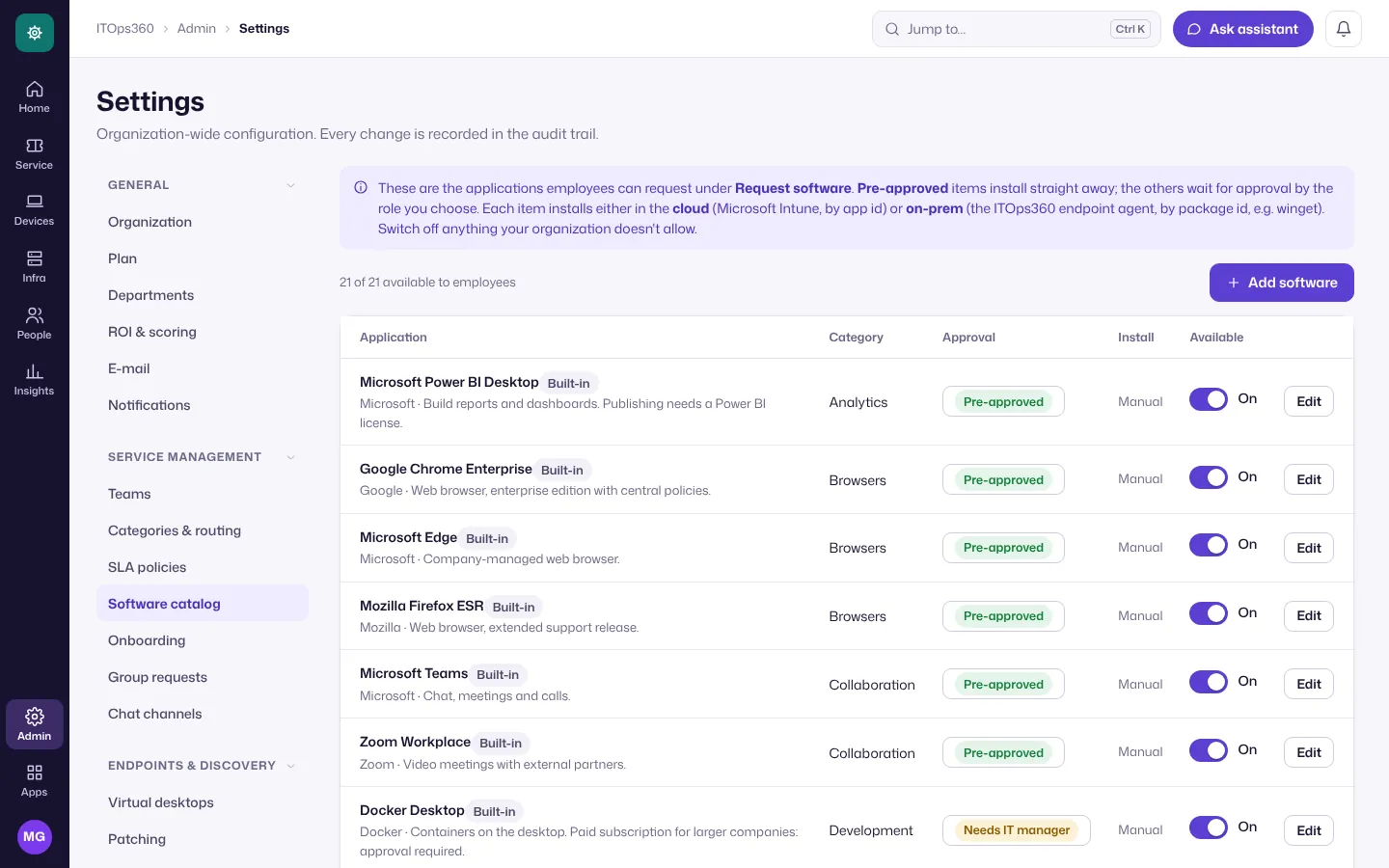
The catalog is the software employees can request under Request software. It starts with common built-in items; the step is done when you add or change one.
-
Choose Open the catalog (or Admin → Settings → Software catalog).
-
For each item, choose Edit to set who approves it (Pre-approved items install straight away), how it installs and whether it’s Available to employees. Switch off anything your organization doesn’t allow.
-
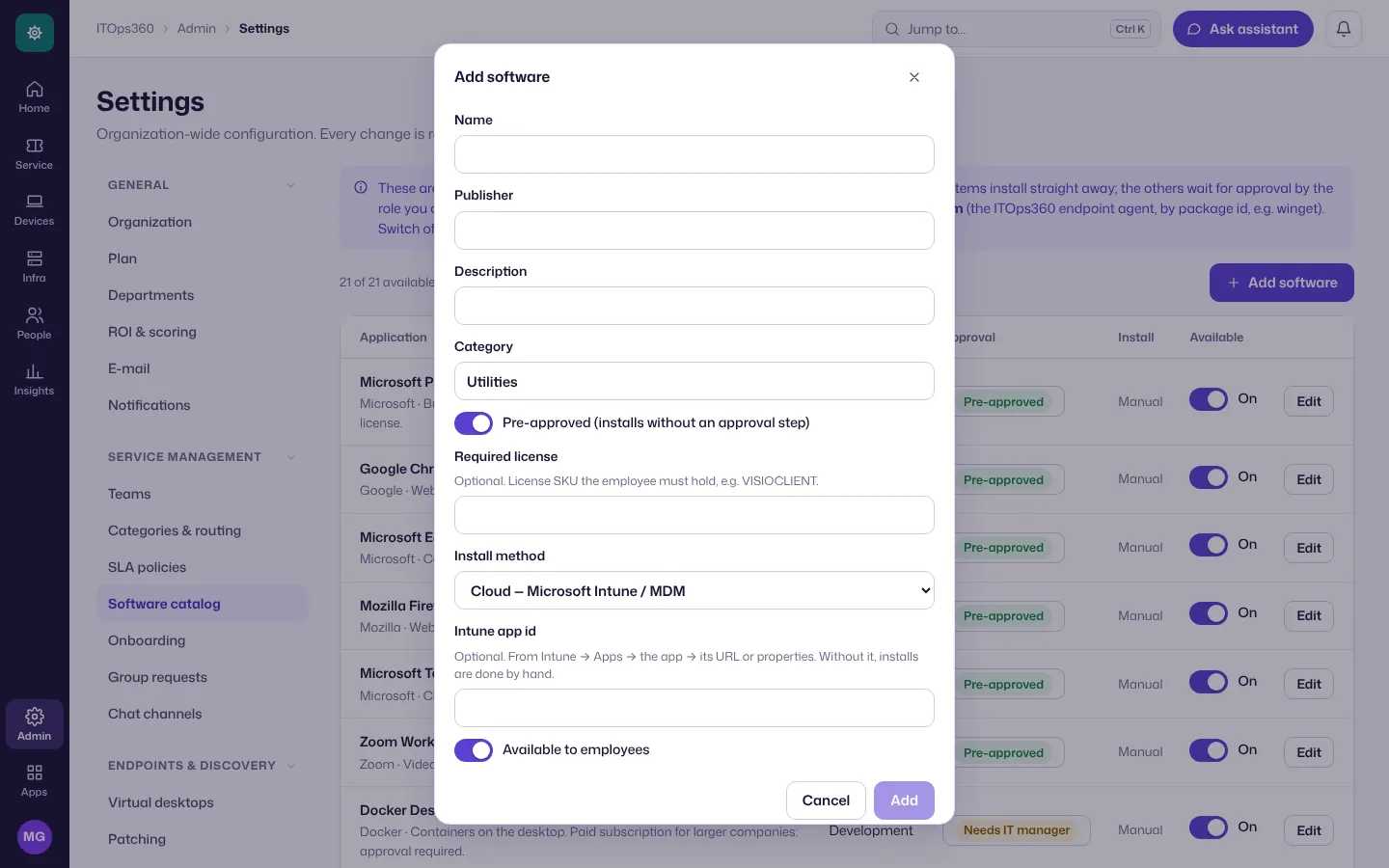
To add your own, choose Add software: name, publisher, category, whether it’s pre-approved or needs a role’s approval, and the install method (Intune app id in the cloud, or a package id such as winget for the ITOps360 agent).
Request forms beyond software are in Employee portal and catalog.
Invite technicians
Technicians are the people who work tickets and look after devices. You invite them in My Apps, like everyone else:
-
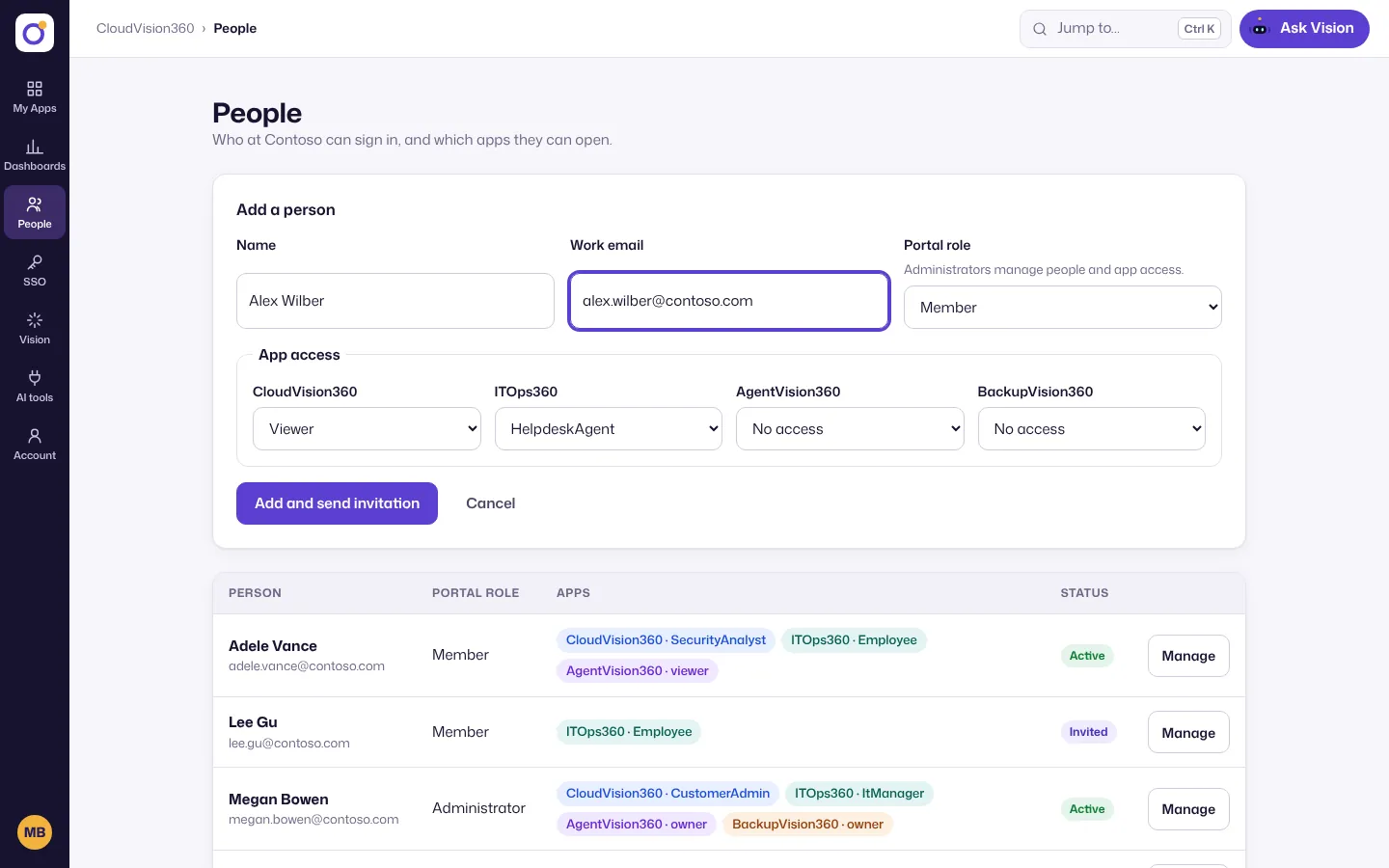
Choose Invite people on the card. It opens People in My Apps.
-
Add person, and under App access give them an ITOps360 role such as HelpdeskAgent, EndpointAdmin or ItManager. Everyone else gets Employee, which can raise and follow requests.
-
They appear in ITOps360 after their first sign-in; the step ticks off then. Technician roles use seats on your plan.
The full walk-through is in Invite your team. Day-to-day use is in Use ITOps360.
Options you can turn on
These options are off or minimal until you set them. Each one has a What does this do? link beside it in the product that explains the same things in brief.
Try the default SNMP community
In Admin, Settings, Discovery, a site collector can also try the read-only community string public on devices that no credential answers. Devices that answer are identified and flagged as a security finding so you can move them to SNMPv3. Nothing is written to any device.
Set up patching rings
Under Admin, Settings, Patching, define up to six rings in order (by default Test, Pilot and Broad), each with its members, updates, deferral and maintenance window. Patch runs need approval and install only inside a ring’s window. The next ring starts after the success threshold is met and the soak period ends.
Sign in with Active Directory
Under Admin, Settings, Active Directory sign-in, enter your domain, domain controllers (LDAPS, port 636), base DN and optional CA certificate, choose a direct connection or a site collector, and map AD groups to roles. Use Test sign-in before you turn it on. Everyone else signs in through My Apps.
Send notifications to Teams, Slack or e-mail
Under Admin, Settings, Notifications, choose Add channel, pick Microsoft Teams, Slack, e-mail or a generic webhook, choose the events and use Test. Without a channel, notifications show in the app only.
Let employees ask for help in Teams or Slack
Under Admin, Settings, Chat channels, connect your own Azure Bot registration for Teams and a Slack app for Slack. Employees chat one to one with the bot using employee rights only, and approvals are never decided in chat.
Set up e-mail to employees
Under Admin, Settings, E-mail, choose how mail is sent, then edit or switch off each message. Preview shows it with sample data, and Recently sent lists what went out.
Tune AI triage
Under Admin, Settings, ROI and scoring, AI auto-categorize above sets how confident a suggestion must be before it is applied. With AI off for your organization, triage uses the built-in rules and nothing is sent to an external model.